// WHY
THE ATLAS
THE ATLAS
The Transfrontier Atlas is one of the primary outcomes of the research project “Towards a cross-border food hub. Mapping the agri-food system of the Isontino territory to strengthen local supply chains”, supported by the Carigo Foundation. It focuses on the Gorizia–Nova Gorica area, treated as a single cross-border region, and aims to provide a shared view of the local food system.
At the national level, this work aligns with a broader shift in which many cities are using food to rethink planning tools for sustainability and resilience. The Milan Urban Food Policy Pact (2015), now signed by more than 260 cities, is one of the most evident signs of this turn, and several Italian cities are developing Food Atlases as shared tools to understand and govern their local food systems.
Within this framework, the Transfrontier Atlas is conceived as an open, participatory, and evolving tool that organises maps, data, and stories to show where and how food connects places, actors, and scales. This perspective underpins two key features of the Atlas:
Not city-centred: a territorial atlas
Unlike many city-based Food Atlases, the Transfrontier Atlas does not take a single city as its main reference. Instead, it follows food practices, spaces, and chains across the wider Isontino territory: agricultural areas, river corridors, hillsides, valleys, and urban spaces of production, distribution, and consumption. Food, in its broader sense, becomes a lens for reading a complex terrain composed of overlapping landscapes and everyday geographies, rather than merely an urban policy issue.
Unlike many city-based Food Atlases, the Transfrontier Atlas does not take a single city as its main reference. Instead, it follows food practices, spaces, and chains across the wider Isontino territory: agricultural areas, river corridors, hillsides, valleys, and urban spaces of production, distribution, and consumption. Food, in its broader sense, becomes a lens for reading a complex terrain composed of overlapping landscapes and everyday geographies, rather than merely an urban policy issue.
Transfrontier: a cross-border knowledge infrastructure
The Atlas is also designed as a cross-border knowledge infrastructure. It brings together maps, data, shared mappings and stories produced on both sides of the state border, weaving together different languages, planning systems and institutional cultures. In doing so, it uses food as a common language to build relationships, acknowledge differences and frame the Gorizia–Nova Gorica area as a shared cross-border region.
The Atlas is also designed as a cross-border knowledge infrastructure. It brings together maps, data, shared mappings and stories produced on both sides of the state border, weaving together different languages, planning systems and institutional cultures. In doing so, it uses food as a common language to build relationships, acknowledge differences and frame the Gorizia–Nova Gorica area as a shared cross-border region.
// WHAT
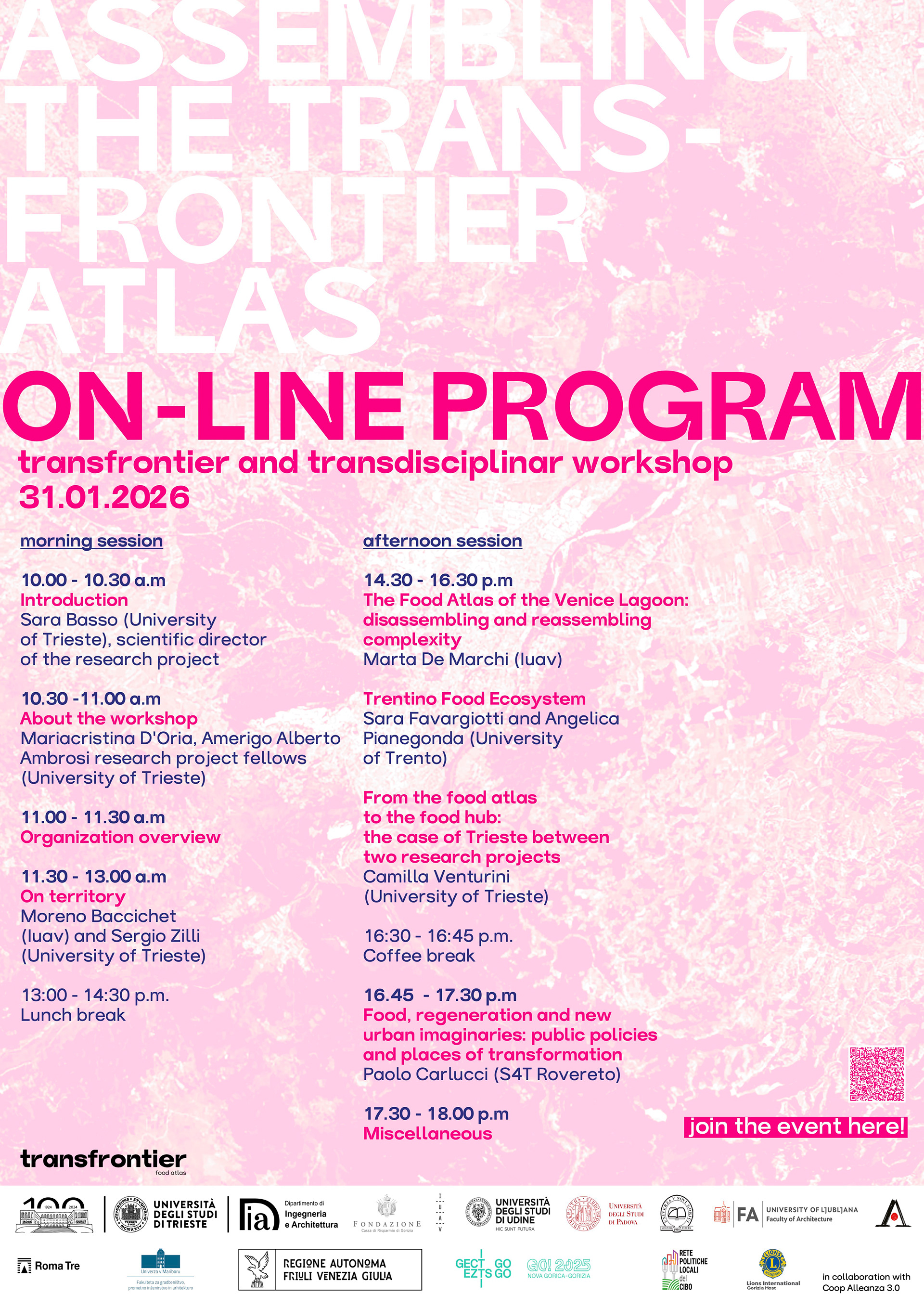
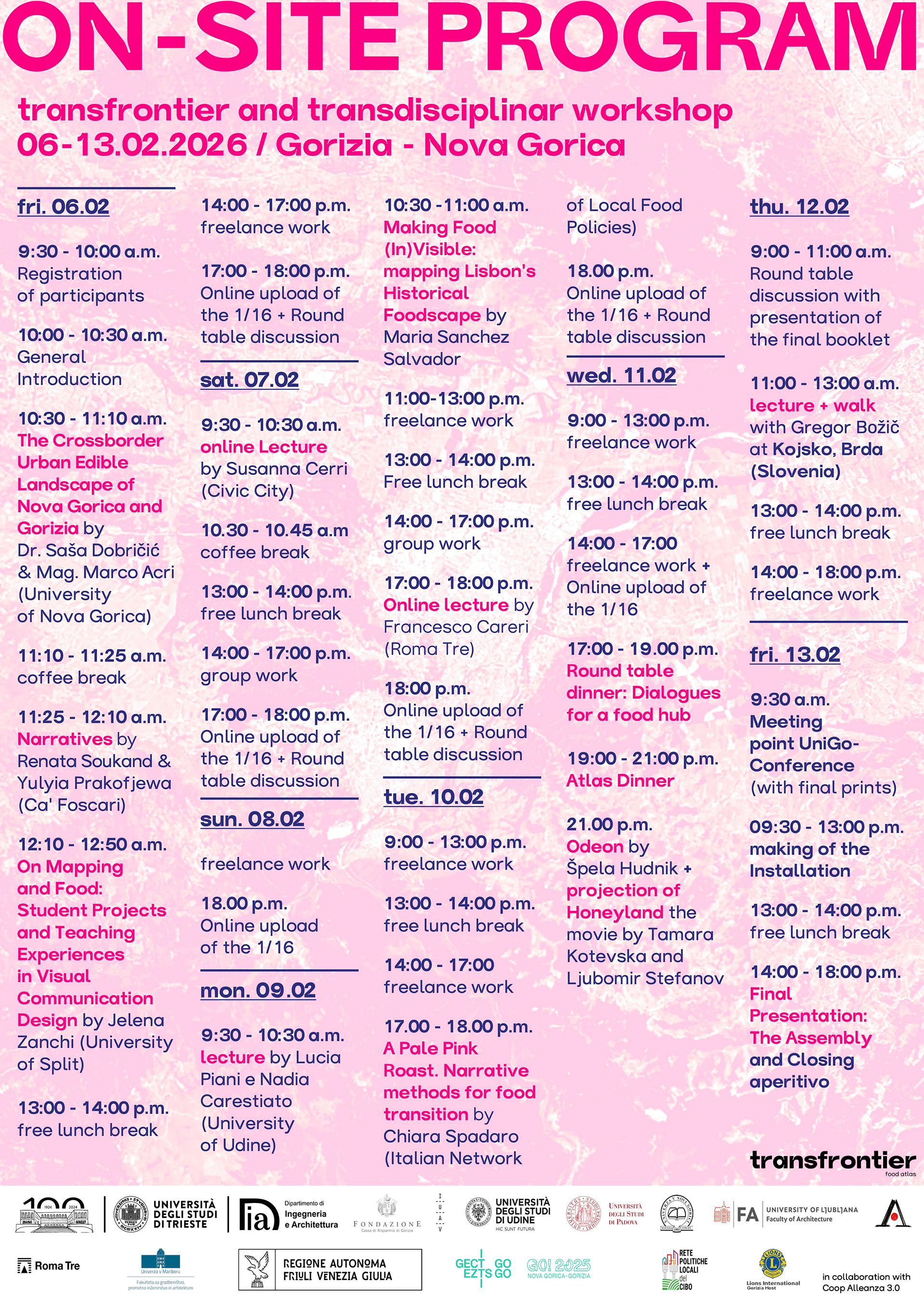
Over two weeks (31st January 2026 –online– and 06–13 February 2026), the “Assembling the Transfrontier Food Atlas” workshop invites students, researchers, practitioners and local activists to take part in the making of the Transfrontier Atlas – the cross-border food atlas of the Gorizia–Nova Gorica area. Participants will work directly in the field and across multiple borders, contributing to a shared tool for understanding this territory through food.
Over two weeks (31st January 2026 –online– and 06–13 February 2026), the “Assembling the Transfrontier Food Atlas” workshop invites students, researchers, practitioners and local activists to take part in the making of the Transfrontier Atlas – the cross-border food atlas of the Gorizia–Nova Gorica area. Participants will work directly in the field and across multiple borders, contributing to a shared tool for understanding this territory through food.
Activities are distributed between Italy and Slovenia and are grounded in continuous movement and dialogue within transdisciplinary groups. The workshop focuses on the need to move beyond conventional boundaries, examining their contemporary fragility and aiming to reveal systems, landscapes and networks of continuity, coexistence and collaboration that often remain invisible.
The programme combines short lectures – conceived as theoretical and practical capsules – with extensive fieldwork. Morning inputs will provide tools, references and methods; afternoons will be dedicated to on-site exploration, data collection and collective interpretation. By the end of the workshop, participants will have produced concrete materials (maps, interviews, visual narratives, short “sixteenths”) that will feed into the Transfrontier Atlas and inform its future development.
Given the heterogeneous, multimedia and multi-material nature of the Atlas, three working groups have been established, each focused on a specific device and angle. These three lines of work – Food Chains: Cross-Border Narratives, Systems of Continuity: Revealing Hidden Patterns, and Hybrid Stories: Retracing Landscapes – are developed through three main tools: mapping in a broad sense (participatory mappings, desk-based work, psychogeographies and “dérives”); active archival research (analysis of archival collections combined with field verification through photography, photomontage, video and field recordings); and interviews with people and materials, tracing the agency of heterogeneous objects and voices through individual or group conversations, more or less structured, that bring out embedded and under-the-radar stories, new narratives, lost landscapes and new assemblages.
FOOD CHAINS: CROSS-BORDER NARRATIVES.
Collecting testimonies, stories and accounts that support an interpretation of the Slovenian–Isontino territory as a single, heterogeneous continuum, in which food cultivation and processing practices, recipes, products, etc. have been layered and disseminated over time.
Tools: interviews (individual and group, more or less structured), in-situ observations, and mapping in a broad sense (participatory mappings, desk-based work, psychogeographies and “dérives”). Where applicable, the group can also rely on active archival research and field-based media (photography, photomontage, video, field recordings) to trace the agency of heterogeneous objects and voices through conversations that bring out embedded and under-the-radar stories, new narratives, lost landscapes, and new assemblages.
Goal: conduct a series of interviews in the Gorizia area and one in the Nova Gorica area
Themes, places and keywords: food justice, food access, agro-industry actors; everyday food practices; forms of care around food
Collecting testimonies, stories and accounts that support an interpretation of the Slovenian–Isontino territory as a single, heterogeneous continuum, in which food cultivation and processing practices, recipes, products, etc. have been layered and disseminated over time.
Tools: interviews (individual and group, more or less structured), in-situ observations, and mapping in a broad sense (participatory mappings, desk-based work, psychogeographies and “dérives”). Where applicable, the group can also rely on active archival research and field-based media (photography, photomontage, video, field recordings) to trace the agency of heterogeneous objects and voices through conversations that bring out embedded and under-the-radar stories, new narratives, lost landscapes, and new assemblages.
Goal: conduct a series of interviews in the Gorizia area and one in the Nova Gorica area
Themes, places and keywords: food justice, food access, agro-industry actors; everyday food practices; forms of care around food
SYSTEMS OF CONTINUITY: REVEALING HIDDEN PATTERNS.
Assembling maps that show how “the border” is, in many places, and at the same time, nowhere. Perhaps it's just a mark on the satellite map within broader, permeable, and traversable systems: soils, edible landscapes, ecological corridors, and natural systems that constantly cross political boundaries.
Assembling maps that show how “the border” is, in many places, and at the same time, nowhere. Perhaps it's just a mark on the satellite map within broader, permeable, and traversable systems: soils, edible landscapes, ecological corridors, and natural systems that constantly cross political boundaries.
Tools: mapping and spatial analysis in a broad sense (participatory mappings, desk-based work, psychogeographies and “dérives”), supported by active archival research and field-based media (photography, photomontage, video, field recordings) to verify and enrich spatial hypotheses on the ground.
Goal: to construct maps of continuity systems that cross the border
Themes, places and keywords: edible green corridors; the Collio (understood as a “machine landscape”); the Vipacco Valley; the Isonzo River.
HYBRID STORIES: RETRACING LANDSCAPES.
Through systematic data collection and information retrieval, this working group will trace and reconstruct agricultural and food landscapes that have disappeared and the new ones that are emerging: erased by changes in production methods, economic reasons, by the urban expansion, by shifts in military control along the border, or by large-scale urban transformation projects that have disrupted previously continuous systems, from encroaching woodland, various forms of abandonment and underuse.
Through systematic data collection and information retrieval, this working group will trace and reconstruct agricultural and food landscapes that have disappeared and the new ones that are emerging: erased by changes in production methods, economic reasons, by the urban expansion, by shifts in military control along the border, or by large-scale urban transformation projects that have disrupted previously continuous systems, from encroaching woodland, various forms of abandonment and underuse.
Tools: active archival research (analysis of archival collections), verification of place names and field checks, combined with mapping and interviews with people and materials. These tools are used to trace the agency of heterogeneous objects and voices through individual or group conversations, more or less structured, that bring out embedded and under-the-radar stories, new narratives, lost landscapes and new assemblages.
Objective: to outline outputs that highlight traces of disappeared foodscapes and emerging ones through the study of historical maps, new narratives, and the changes that occur and pass through every day in this mosaic territory.
Themes, places and keywords: areas grafted onto the border (e.g., Campi di Salcano—area between Via dei Campi, the state border, and the Isonzo River).
//OUTPUTS
At the end of each day, an instant report will be requested (paper format: sixteenth, i.e. an A4 sheet with four blank sides on which to work). Once produced daily and added together at the end, these will constitute the final report: a dossier that will supplement the materials in the atlas.
Reference: https://corraini.com/it/catalogo/riviste/un-sedicesimo.html
At the end of each day, an instant report will be requested (paper format: sixteenth, i.e. an A4 sheet with four blank sides on which to work). Once produced daily and added together at the end, these will constitute the final report: a dossier that will supplement the materials in the atlas.
Reference: https://corraini.com/it/catalogo/riviste/un-sedicesimo.html
//WHO
The workshop is open to undergraduate and master’s students, PhD candidates, University or independent Researchers, activists, practitioners, and anyone involved in these topics.
// LANGUAGE
The workshop will be conducted in English.
The workshop is open to undergraduate and master’s students, PhD candidates, University or independent Researchers, activists, practitioners, and anyone involved in these topics.
// LANGUAGE
The workshop will be conducted in English.
. . . . . . . . . . . . . . . . . . . . . . . . .
ORGANIZING COMMITTEE
Sara Basso (UniTS)
Amerigo Alberto Ambrosi (UniTS)
Mariacristina D'Oria (UniTS)
Camilla Venturini (UniTS)
. . . . . . . . . . . . . . . . . . . . . . . . .
SCIENTIFIC COMMITTEE
Sara Basso (UniTS)
Sergio Zilli (UNiTS)
Saša Dobričič (UNG)
Francesco Visentin (UniUD)
Nadia Carestiato (UniUD)
Lucia Piani (UniUD)
Marta De Marchi (Università Iuav di Venezia)
Julia Prakofjewa (Ca' Foscari University)
Renata Soukand (Ca' Foscari University)
Sara Favargiotti (UniTN)
Catherine Dezio (UniPD)
Chiara Spadaro (UniPD)
Špela Hudnik (FA.UNI.LJ)
Jelena Zanchi (Academy of Art, University of Split)
Moreno Baccichet (Università Iuav di Venezia)
Francesco Piccio Careri (RomaTre)
Susanna Cerri (Civic City)